
We work with service businesses at very different stages, and the gap in website traffic between them can be enormous. Some have barely any visitors at all but still need a professional web presence for potential clients who want to check them out before getting in touch. Others are pulling in significant traffic that simply isn't converting into the enquiries and bookings they'd expect.
So where does your website sit, and how much traffic is actually enough?
Before you read on, one quick but important point: you need to know how much traffic your website gets each month - all traffic, not just from search. Any basic analytics tool will show you this. If you don't have one set up, that's the first thing to fix. And if Google Analytics is making you want to claw your eyes out, here are some alternatives.
This article is aimed at service-based businesses. It doesn't cover e-commerce or sites monetised through advertising or affiliates.
Less than 300 visitors per month
Low traffic doesn't necessarily mean no leads. If you offer something genuinely niche with little direct competition, even a handful of monthly visitors can convert well, because the people finding you are already looking for exactly what you do. But for most service businesses, low traffic means low visibility in a crowded space, and that's worth taking seriously.
At this stage, it's also worth being clear about what your website's job actually is. For many businesses with under 300 monthly visitors, the site isn't generating inbound leads... and it probably shouldn't be expected to yet. Its primary job is credibility: giving people who've already heard of you somewhere professional to land. That still matters, and it's worth investing in.
If you want to grow traffic, SEO is the obvious route, but it's slow, competitive, and doesn't suit every business. If you're considering paid search as a faster alternative, it can work, but only when it's set up with the right strategy behind it. Find out if Google Ads is right for your business.
Beyond search, there are visibility strategies that don't rely on Google at all - and for many service businesses, these drive more targeted traffic and faster feedback than SEO ever would. Here's our guide to the best alternative visibility strategies.
300 - 1000 visitors per month
If you're consistently getting between 300 and 1,000 visitors per month, you have enough traffic to start drawing meaningful conclusions.
At this stage, the question shifts from "how do I get more traffic?" to "what is this traffic actually doing?" A 1-2% conversion rate is realistic for a B2B service business. At 500 visitors a month, that's five to ten enquiries if your website is doing its job properly. If you're getting significantly less than that, more traffic isn't the answer.
This is the point where conversion optimisation becomes worthwhile. That means looking critically at whether your website reflects your expertise, speaks directly to the right people, and makes it easy for them to take the next step. If you're not sure where the problem lies, these are the five areas I'd check first.
Whatever you're working on, keep your ideal client and their decision-making process front of mind with every change you make.
1000 - 10,000 visitors per month
At this level, if your website speaks directly to the right people and makes it easy for them to take the next step, you should be generating a steady stream of inbound enquiries.
If that's not happening, the most common culprit I see is a traffic quality problem. Businesses at this stage have often cracked the basics of SEO - their site has enough authority, they understand how to find keyphrases, and they know how to write content that ranks. So they keep going. Traffic climbs, but enquiries don't follow.
The issue is that ranking well and attracting the right people are two different things. It's very easy to build an audience of people who are interested in your subject matter but have no intention of hiring you.
Before investing more time or budget into growing traffic further, it's worth pausing to ask who is actually landing on your site... and whether they're ever likely to become clients. Here's my guide on how to do a website traffic quality audit.
10,000+ visitors per month
You might assume that a business with over 10,000 monthly visitors is generating more leads than it can handle. But this is often where enquiries plateau, and where the gap between traffic and revenue becomes hardest to diagnose.
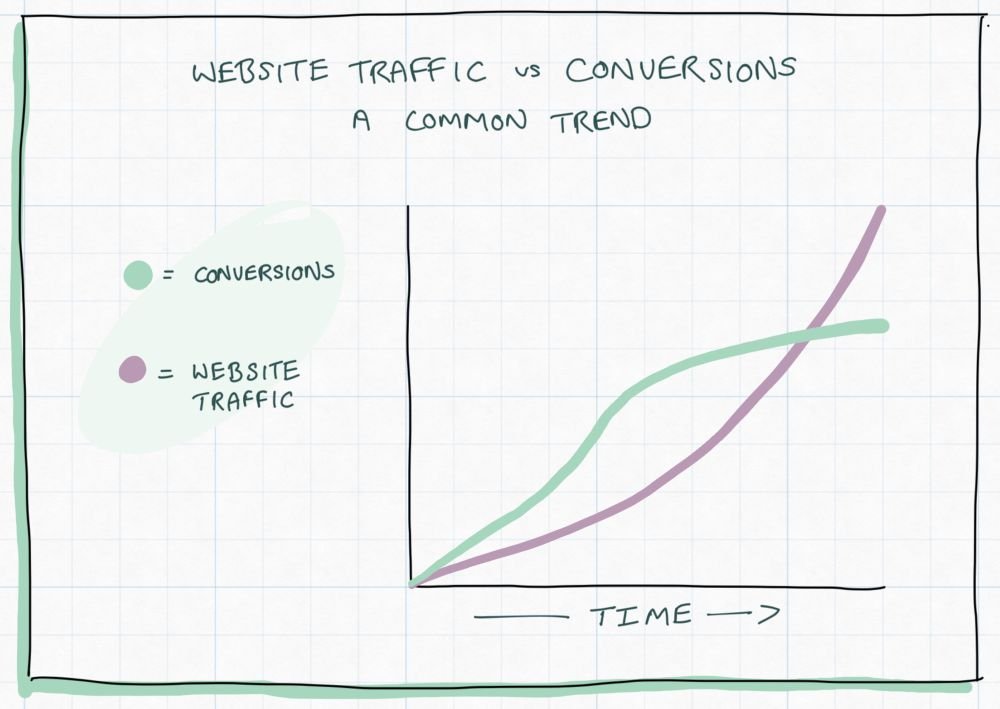
Sites at this level have usually been around for a long time. They've grown and evolved as the business has changed, and a significant chunk of current traffic is often coming from older content that still gets clicks but isn't especially relevant to what the business offers today. Bigger sites also tend to develop navigation and user experience problems over time, particularly if they've grown without much strategic oversight.
The result is a lower conversion rate at exactly the point where the stakes are highest - because businesses with this much traffic are usually relying heavily on their website to bring in new clients.
If a large proportion of your traffic is coming from your blog, the priority is making sure those readers have a clear, low-friction path towards working with you, rather than reading and leaving. Here's our guide on how to turn blog readers into buyers.
Whatever stage you're at, knowing your traffic numbers is just the beginning. The real power lies in understanding what those visitors are doing, and turning that insight into action.